
Why Check RNA Integrity When Concentration and Purity Look Normal?
If an RNA sample has sufficient concentration and an apparently normal A260/A280 ratio, can it go straight into library preparation or reverse transcription? Those two measurements alone are not enough to decide. Concentration, purity, and integrity answer different questions: how much material is present, whether impurities may affect measurement or reactions, and whether the RNA retains the lengths and structures needed for the downstream experiment. Checking these separately is often more useful than repeatedly measuring one purity ratio.
Fragmentation does not eliminate UV absorption
After an RNA chain breaks, its fragments still contain nucleotides that absorb UV light. A260 therefore does not count intact RNA molecules or measure fragment length. DNA, free nucleotides, and extraction residues may also contribute to sample absorbance, further affecting the concentration calculated from A260.
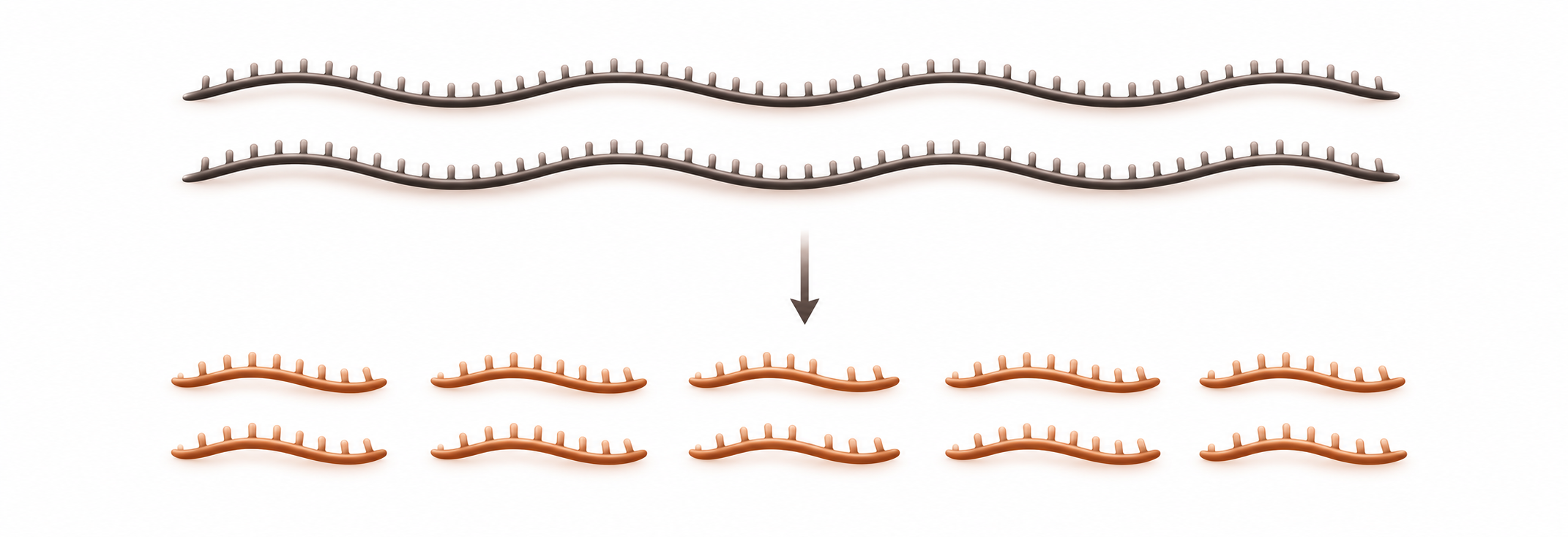
Figure 1. Original conceptual schematic, not a representation of molecular proportions or experimental data. RNA fragmentation changes chain length, but fragments can still contribute to absorbance. The figure does not imply that A260 must remain exactly equal before and after fragmentation; structural changes and measurement conditions also affect absorption.
A260/A280 and A260/A230 are spectral ratios. Even values within commonly used laboratory reference ranges do not establish that RNA is undegraded. Conversely, an abnormal ratio does not directly mean chain breakage. Particularly at low concentrations, with a mismatched blank, or after changes in buffer conditions, first assess whether the ratio itself is reliable before interpreting impurities.
Additional fluorescence quantification still does not replace fragment analysis
An appropriate RNA fluorescence quantification reagent can provide another concentration estimate, but a routine concentration assay does not directly provide the distribution of chain lengths. Reagents also differ in their response characteristics for RNA types, fragment lengths, and sample matrices; follow the corresponding instructions. Agreement between UV and fluorescence concentrations does not establish acceptable integrity, and disagreement alone cannot determine the extent of degradation.
If the downstream experiment requires longer or intact templates, add a check that reflects fragment distribution, such as an appropriate denaturing gel or capillary electrophoresis method. The aim is evidence that addresses the question, rather than asking a concentration measurement to describe a property it has not measured.
Interpret integrity metrics in the context of sample type
RIN stands for RNA integrity number. The original method assesses RNA status using features from multiple regions of an electropherogram, rather than simply calculating a 28S/18S peak ratio. The common RIN scale runs from 1 to 10, with higher values generally corresponding to more intact RNA. However, interpret the value together with the original electropherogram, sample type, and analytical method.
For typical eukaryotic total RNA, changes in ribosomal RNA features and the short-fragment background can be examined. Do not mechanically apply the same expected peak pattern to enriched mRNA, small RNA, synthetic transcripts, or other materials that do not have the same total-RNA profile. If an algorithm gives no value or an unfavorable value, that does not automatically make the sample unsuitable for every purpose.
RNA extracted from formalin-fixed, paraffin-embedded (FFPE) tissue is often already fragmented, so some library preparation workflows use length-distribution metrics such as DV200 to further characterize samples. DV200 usually describes the proportion of RNA fragments longer than 200 nucleotides, reported by the relevant platform using its specified analysis regions and calculation method. It is not another unit for RIN and cannot be calculated from A260/A280.
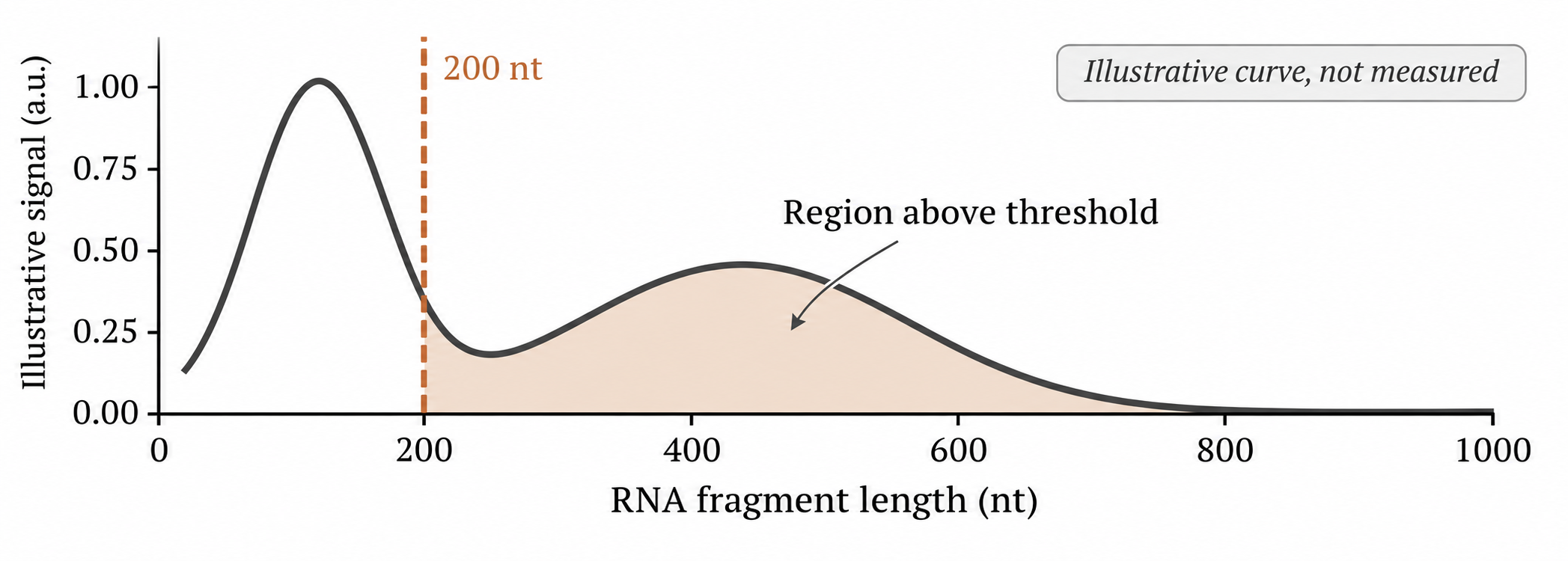
Figure 2. Original mathematical curve illustrating only the length threshold and analysis region. It is not an actual electropherogram and must not be used to generate RIN or DV200. Actual proportions must be calculated according to the platform’s rules for analysis regions, baseline treatment, and marker exclusion; visual comparison of curve heights or manual point counting cannot replace that calculation.
A common misuse is to impose a single acceptance threshold. Different library preparation reagents, enrichment approaches, and target read lengths have different starting-RNA requirements. A manufacturer’s RIN or DV200 threshold for a particular workflow must be interpreted within that workflow, rather than adopted as a universal standard for all RNA experiments.
Let downstream requirements determine whether to proceed
First specify whether the sample is total RNA, enriched RNA, or synthetic RNA and which experiment is planned. Then establish three separate types of information: concentration and total amount, impurity risk, and fragment distribution. The aliquot used for measurement should represent the material that will be used. Record the sampling time and storage and handling history, so that a favorable earlier measurement does not stand in for the current condition.
If concentration and spectral ratios are normal but the fragment distribution shows substantial fragmentation, do not try to “compensate for integrity” simply by increasing input mass. More mass cannot reconnect broken chains. Check whether the downstream workflow supports such material, whether input or fragmentation steps need adjustment, and how interpretation will be limited. Base adjustments on the specific reagent workflow rather than combining parameters from different manufacturers.
If a fragment trace shows unusual peaks, an abnormal baseline, or a clearly out-of-range signal, do not immediately label the sample “degraded.” First check whether the method suits the sample, whether the input is too high or too low, and whether the markers and run are normal. Then decide whether to repeat the measurement or use another method. Electrophoretic quality control must itself be valid before it can assess RNA.
State suitability as a conditional conclusion
A useful handoff record can include sample type and extraction source, quantification method, concentration and available volume, spectrum and purity ratios, integrity-testing method and original trace, RIN or DV200 where applicable, and the intended downstream workflow and its acceptance criteria. Stating that the sample “meets the input requirements of a specified workflow” is more accurate than broadly calling it “high-quality RNA,” and helps later investigation of failures.
Evolstorm’s technical content focuses on the boundaries between different measurement results. For specific devices such as NANO X1, the conclusions supported by concentration, spectrum, or purity information must be determined from the relevant version of the documentation. UV-Vis readings alone cannot support claims of RIN, DV200, or certified integrity. Integrity requires independent evidence from an appropriate test.