
Why can qPCR fail when concentration looks normal?
Why can qPCR fail when the measured DNA concentration looks normal?
Absorbance or fluorescence quantification answers a concentration question defined by the measurement method. qPCR also depends on amplifiable target, reaction conditions and inhibitors. A single concentration result cannot exclude inhibition or establish suitability for every downstream method.
Set up comparable dilutions
Using a validated diluent and the same input volume, compare the undiluted sample with at least one known dilution, with replicates. Dilution reduces both target and potential inhibitors. Record dilution factors, curves and undetected results rather than comparing raw Ct alone.
Understand the expected shift using a twofold dilution
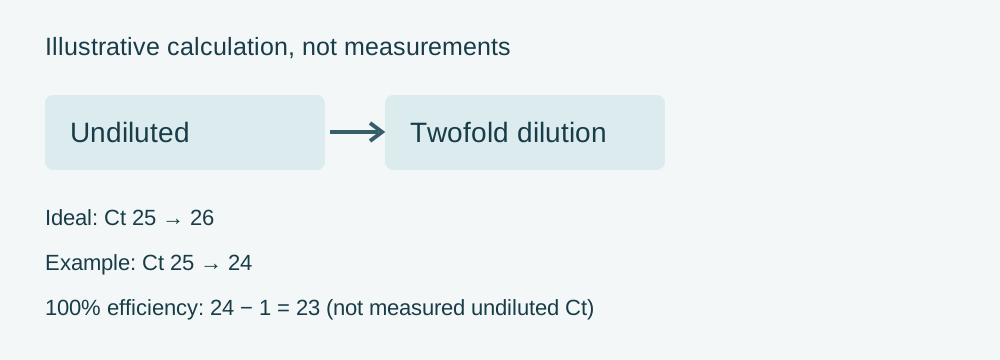
In an ideal reaction with a per-cycle amplification factor of 2, halving the same target delays Ct by about 1 cycle. If the undiluted sample has Ct 25.0, a twofold dilution would be expected near 26.0. If the observed Ct is 24.0, its equivalent Ct adjusted to the original input, assuming ideal 100% efficiency, is 23.0. This is not the measured undiluted Ct and does not establish that inhibition has been eliminated. The discrepancy may suggest reduced inhibition, but pipetting, baseline settings, random variation and other causes are also possible. These numbers are a calculation example, not measurements.
Different controls answer different questions
A no-template control helps detect contamination introduced by reagents or handling. An external positive control helps check whether the reaction can amplify a known target. An endogenous or exogenous internal control can provide evidence about effects in that sample. Addition stage, recovery, competition and sensitivity affect interpretation: a control added before PCR alone cannot establish that extraction worked. A control added to the original sample and diluted with it also decreases in copy number, so its Ct should not be expected to stay constant across dilutions. A normal internal control in a negative sample does not exclude every target-specific problem.
Dilution has a cost
Dilution may reduce inhibitor concentration, but it also reduces target copies. Near the detection limit, random sampling can cause variable replicates or undetected results; an undetected result is not evidence that inhibition is absent. Investigate unexpected signal or adjusted results using controls, curve quality, replicates and the validated method. Re-purify or revise the procedure when appropriate.
Keep the evidence needed for interpretation
Record sample identity, measurement method, diluent and dilution factor, input volume, controls and when they were added, Ct and undetected results, method version and observations. Interpret using the specific reagent instructions and laboratory validation. This article proposes no universal decision threshold and does not replace clinical or quality-system requirements.