
Why is one concentration number not enough for a sequencing library?
The methods answer different questions
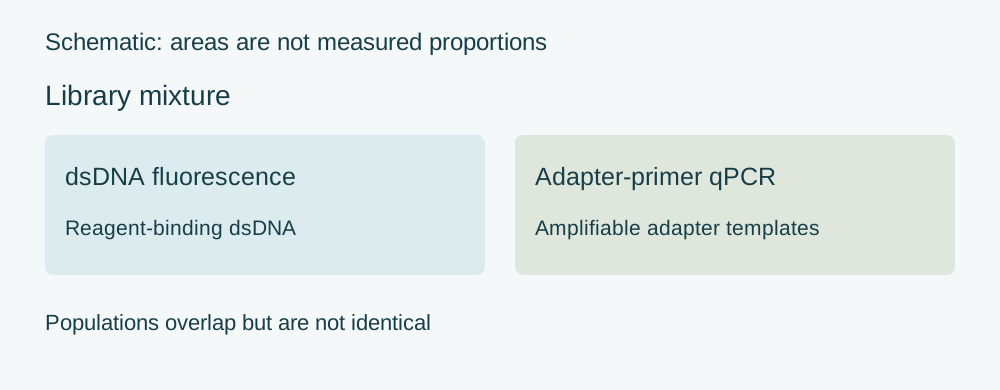
Several values reported as library concentration before sequencing can refer to different populations. A double-stranded DNA fluorescence assay mainly responds to dsDNA that its reagent can bind. Adapter-primer qPCR measures templates amplifiable by that primer set under its reaction conditions. A difference does not by itself prove that an instrument is wrong, and there is no universal fixed conversion between the results.
Separate input DNA from the finished library
Input DNA before library preparation and the prepared library are different stages with different purposes and applicable methods. A suitable fluorescence assay can estimate dsDNA mass concentration, but free dsDNA, partially constructed products and adapter dimers may contribute. Response depends on the reagent, molecular structure and procedure; do not assume all contaminants respond equally.
Adapter qPCR provides more targeted evidence
For example, an Illumina adapter-primer assay requires sequences that bind its primers. Amplifiable does not mean the insert is correct, the sequence is intact, or the sample will necessarily produce high-quality reads. Adapter dimers bearing primer-binding sites may also amplify. Consider fragment distribution, positive and negative controls, standards and the specific assay instructions; a qPCR value alone is not a complete quality assessment.
Fragment length connects mass and molar concentrations
Where the double-stranded DNA approximation applies, mass concentration, molecular concentration and fragment length are related. With a broad length distribution or dimers, converting total mass concentration to molarity using one average length can obscure mixture differences. A mismatch between standard and library size ranges may also affect a particular qPCR assay. Use the size or correction prescribed for the specific method.
Follow the library-specific workflow
There is no single best method for every library chemistry. For example, an Illumina instruction for manual normalization of Nextera XT libraries calls for fluorometric quantification with fragment analysis and does not accept qPCR quantification for that workflow; other libraries or platforms may recommend adapter qPCR. Single- and double-stranded libraries require suitable assays. Do not generalize a recommendation from one manufacturer and version to every PCR-free library.
Keep the result traceable
Record library type and stage, kit and version, measurement method, dilution factor, concentration unit, fragment length or distribution, controls and unusual results. Use the method-specific standards and decision rules for repeats or next steps. An absorbance purity ratio, fluorescence value or qPCR result alone cannot guarantee downstream success.