
Does a visibly clean sample surface rule out carryover?
A sample surface with no visible marks is a useful initial observation. It does not, by itself, show that the previous sample has an acceptably small effect on the next one. Separate three questions: whether residue is visible, whether the current blank background is suitable, and whether a high-concentration sample causes detectable carryover afterwards.
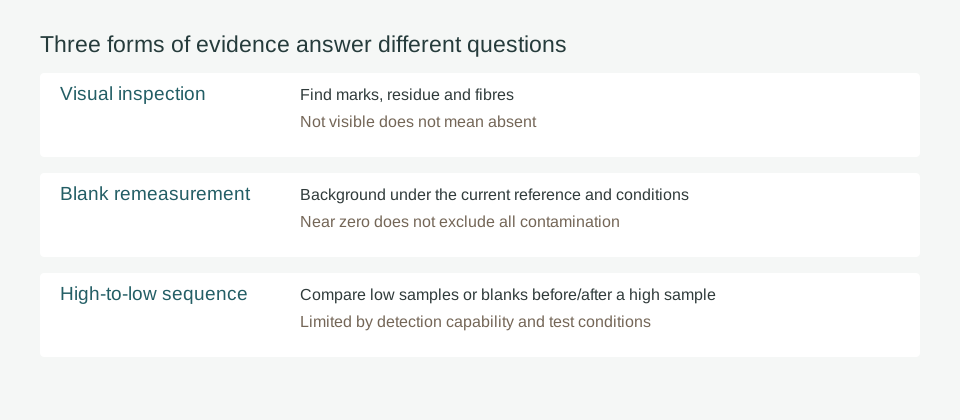
Visual inspection, a blank, and carryover answer different questions
Inspection can reveal droplets, dried material, or fibres; an invisible contaminant may still be present. Establishing a reference with a matched blank, then measuring a fresh aliquot of that blank as a sample, checks background under the current settings and blank material. But if residue was already present when the reference was established, one subsequent result near zero cannot rule out its being subtracted with the reference, nor establish suitability for every sample and method.
A carryover check focuses on sequence: under a defined cleaning procedure, compare a low-concentration control or blank before and after a high-concentration sample. Interpret the comparison in light of detection capability, variability, sample matrix, and acceptance criteria defined beforehand. Fresh pipette tips and aliquots and consistent handling help reduce differences introduced by the check itself. Where trace nucleic acid contamination matters, use an independent method suited to the downstream risk; a near-zero absorbance result is not proof of absolute molecular-level absence.
Check the cleaning instructions for the actual instrument
Manufacturers use different materials and measurement-head designs, and their cleaning-agent guidance can differ. Consult the current instructions for the instrument, model, and head, and select an approved procedure for the residue. Do not transfer another instrument's solvents, duration, or wiping force directly. Both contacting surfaces may encounter sample; identify the actual areas in the relevant manual. If an abnormal result persists, retain the handling and spectral records and contact the appropriate support team.
To qualify cleaning for a workflow, define sample type, maximum concentration, the subsequent low-concentration sample, and acceptable impact before designing a high-to-low sequence with adequate repeats. A negative result supports only the tested conditions and the detection capability of that test; it does not establish absence of contamination for all samples, concentrations, methods, or downstream PCR. This article explains principles, is not a cleaning SOP, and does not report an in-house instrument experiment.