
Why Coordinate Temperature Control and Timing for Standards and Samples in Fluorescence Quantification?
Changing readings from the same tube of nucleic acid or protein solution do not necessarily mean that the sample concentration has actually changed. In fluorescence quantification that depends on a dye reaction, reaction time and temperature also affect the reading. When troubleshooting, first ask whether standards and samples were measured under comparable conditions. Even a good standard curve cannot automatically remove the difference between comparing one in a cold state and the other in a warm state, or one just mixed and the other fully incubated.
Quantification compares responses under the same conditions
Fluorescence quantification does not translate a fixed brightness directly into concentration. The instrument establishes a relationship between signal and analyte amount using standards, then interprets unknown samples using that relationship. It reflects the combined effects of the reagent, reaction system, and measurement conditions. Choosing the correct reagent is therefore only the first step; standards and samples must also have comparable volumes, incubation times, and temperatures as required by the method.
Coordination here does not mean starting and reading every tube at the same second. What matters is the time each tube spends between mixing and measurement, and the state of the solution when it is read. Sequential preparation can be followed by sequential measurement, or samples can be divided into small batches. Do not start timing the entire batch when the first tube is prepared and then measure the last tube immediately after adding its reagents.
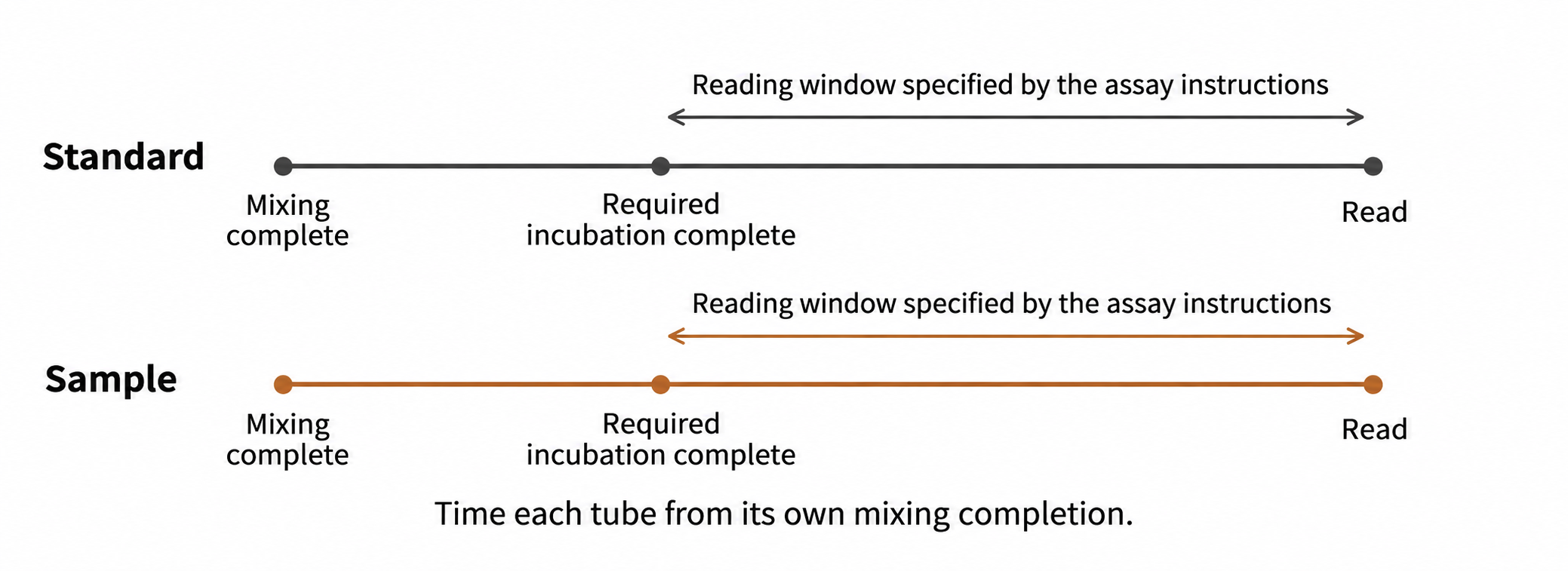
Figure 1. Original workflow schematic, not experimental data. The two timelines illustrate only the operating logic; spacing does not represent minutes. The minimum incubation time, permitted reading window, and timing difference between standards and samples must follow the instructions for the specific reagent.
Waiting times are not interchangeable between fluorescence reagents, and rules for nucleic acid reagents cannot be applied directly to protein reagents. If the instructions specify both a minimum incubation time and a signal-stability window, both must be met. Waiting longer is not always safe. A more flexible measurement schedule is appropriate only when supported by the instructions or the laboratory’s method validation.
Room temperature does not simply mean placed on the bench
A reagent taken from refrigerated storage may look normal without having equilibrated to the bench temperature. Conversely, holding a reaction tube in the hand or leaving it in the measurement chamber for a prolonged period may also change the solution temperature. Some common nucleic acid and protein fluorescence reagents produce lower signals as temperature rises, but the direction and magnitude depend on the system; no single percentage correction should be applied to every dye.
Distinguish storage conditions from measurement conditions. A component that requires refrigerated storage does not necessarily need to be measured on ice. Likewise, a requirement for temperature equilibration before measurement does not permit long-term storage of the entire kit at room temperature. Check the storage and use requirements for each component in the relevant reagent version, prepare working solutions as instructed, and do not change storage conditions for convenience.
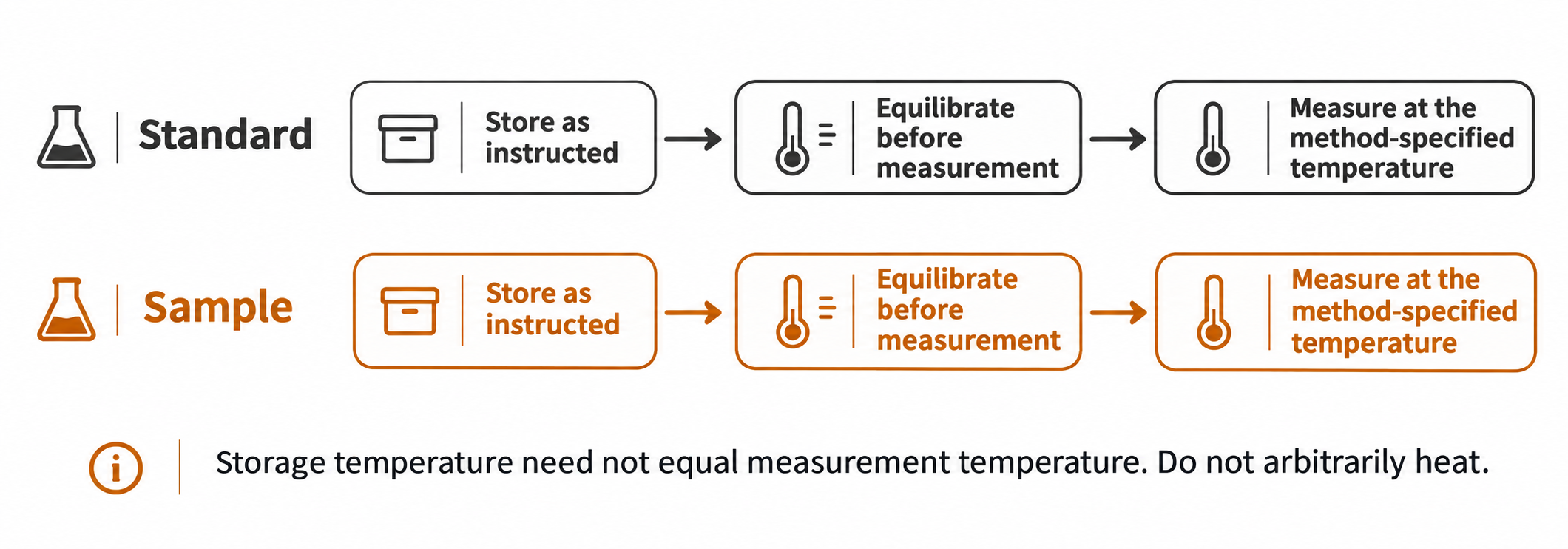
Figure 2. Original operational schematic, not measured temperature data. Standards and samples must reach the measurement temperature required by the method. Arbitrarily heating both is not a substitute for the specified conditions.
Before rereading the same tube, remove it from the measurement chamber as directed by the instructions and restore the specified measurement conditions. A trend produced by repeatedly clicking to read may include temperature effects from time spent inside the instrument, as well as illumination, mixing, or other effects. A declining value alone does not establish sample degradation or dye failure. Nor should the lowest or highest reading be selected as the “truer” result.
Organize a traceable measurement batch
Before starting, record the reagent name and version, lot number, measurement mode, temperature requirements, minimum incubation time, and latest permitted reading time. Divide samples into batches according to a realistic working pace, record when mixing is complete for each tube or small batch, and read standards and samples in sequence. Keep reaction tubes in a rack to reduce hand warming and unnecessary waiting. Where protection from light is required, follow the reagent instructions rather than extending exposure on your own.
If the batch is so large that the last tubes may exceed the specified window, reduce the batch size in advance rather than changing the rules halfway through measurement. For comparisons across batches, remeasure standards as required by the method and retain batch information. Software support for reusing an earlier calibration does not establish that the calibration is suitable for today’s reaction conditions.
Perform a controlled check when readings change
First retain the original readings, reading order, and times; do not begin by deleting values that look wrong. Confirm that the reagent matches the instrument mode and that the result is within the valid range. Then check whether standards and samples experienced different temperatures, incubation times, or illumination. At the same time, inspect the outside of the tubes for droplets or marks, and check for bubbles and adequate mixing, rather than attributing every change to temperature.
If a clear timing or temperature deviation is found, prepare an appropriate number of standards and representative samples again using the same method and check them under the specified conditions. Agreement after restoring the conditions supports operating conditions as one contributing factor; it does not prove that all other errors have disappeared. If disagreement remains, continue checking pipetting, dilution factors, matrix compatibility, and reagent condition. Provide original data to technical support when necessary instead of simply adding more repeats.
Recording conditions is more useful than pursuing an attractive number
At a minimum, retain sample identification, reagent and lot number, preparation volumes, dilution factors, mixing-completion and reading times, measurement-temperature conditions, standard readings, handling of anomalies, and the basis for accepting the final result. For important samples, defining repeat-measurement and acceptance rules before looking at the results helps reduce the risk of selecting data after the fact.
This approach applies to fluorescence quantification that requires dye reactions and calibration with standards. It is not a universal operating procedure for all luminescence, fluorescence-kinetics, or cell-based assays. If a specific method requires constant temperature, a particular reaction time, or other controls, follow that method.
Related applications
Evolstorm focuses on whether the conditions underlying measurement results are traceable. When choosing an approach to microvolume sample analysis, evaluate the instrument, reagents, consumables, and workflow together. Do not treat the general troubleshooting principles in this article as a statement of NANO X1 fluorescence compatibility or temperature-control capabilities. Whether a specific model and configuration support the target method requires confirmation from the relevant version of the documentation.