
Why dilution-corrected concentrations may still disagree
A diluted sample gives a lower reading, yet multiplying by the dilution factor does not reproduce the earlier result. Before attributing the difference to the instrument, separate preparation, measurement and reporting. Multiplication changes the concentration scale; it cannot establish that preparation was correct, sampling was representative or the reading was within the method's valid range.
Express “tenfold” as volumes that can be checked
Here the dilution factor is D = final volume Vf / original-sample volume Vs. If the diluent contains no analyte, the analyte is conserved during preparation, the solution is homogeneous and concentration definitions agree, original concentration c₀ = diluted-sample concentration c_d × D. Volumes must use matching units. The aqueous examples below assume additive volumes, with no loss or reaction.
Taking 10 µL of original sample and adding 90 µL of diluent gives 100 µL and D = 10. Taking 10 µL and adding 100 µL gives 110 µL and D = 11. “1:10” alone can confuse the sample-to-diluent ratio with the sample-to-final-volume ratio. Record all three volumes and D so another person can reconstruct the operation.
When a method requires making up to volume, Vf is the actual final volume under the specified conditions; adding the two nominal volumes is not universally valid. A pipette setting is also not a verified delivered volume.
Correct arithmetic can start from the wrong factor
Consider a constructed example with an original concentration of 100 ng/µL. The plan is to transfer 10 µL and add 90 µL of diluent, then use D = 10. If the volumes match the plan, the diluted concentration is 10 ng/µL and back-calculation gives 100 ng/µL.
Now suppose only 9 µL of original sample is actually transferred, while diluent remains 90 µL. The actual final volume is 99 µL and the actual factor is 11. The diluted concentration is approximately 9.09 ng/µL. Applying the planned factor of 10 gives approximately 90.91 ng/µL, 9.09% below the stipulated original value. The instrument is assumed to be perfectly correct in this example.
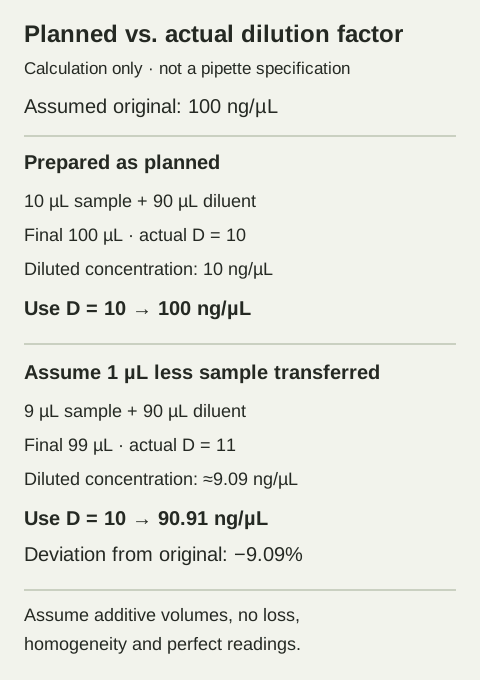
Original calculation schematic, not measurements or pipette specifications. Only the transferred original-sample volume differs; both paths use the planned factor of 10, correctly in one path and incorrectly in the other.
The 9 µL transfer is deliberately chosen for illustration, not a claim about normal pipetting error or evidence that an instrument fails its specification. Diluent volume can also deviate; the directions of the two relative volume deviations affect the final ratio.
For sequential dilutions, multiply the factors: two tenfold steps give a factor of 100, not 20. Later steps carry forward earlier preparation deviations. An extra step may nevertheless make an otherwise impractically small transfer manageable. Compare reliably deliverable volumes, total operations, sample use and purpose when choosing direct or serial dilution; step count alone is insufficient.
Dilution can change measurement conditions too
Mix the stock and diluted sample using procedures appropriate for the material, maintaining homogeneity when sampling. Repeated readings from one diluted tube do not independently test whether that tube was prepared correctly. Stable results can still be shifted.
The diluted sample must remain within the valid range for the method, optical path and sample type. An additive concentration-reading deviation is carried back to the original scale by D. In a separate arithmetic example, a +0.10 ng/µL deviation in c_d with an exact D of 10 produces a +1.0 ng/µL deviation after correction. This does not assume constant instrument error and is not a complete uncertainty calculation.
Diluent can also change the matrix. Different stock buffer and diluent can alter the final pH, ionic environment or background absorbance. Prepare a blank representing the solvent background at measurement according to the applicable method. Multiplication cannot remove background mismatch, and water is not automatically a suitable diluent for every sample. Mixing high-molecular-weight nucleic acids must also respect integrity requirements; a general handling suggestion is not a universal SOP.
Check whether the report has already applied the factor
Suppose the diluted sample measures 10 ng/µL and software has applied D = 10 to display an original-sample result of 100 ng/µL. Multiplying by 10 again would falsely report 1000 ng/µL. Treating the uncorrected 10 ng/µL as the original concentration would instead underestimate it tenfold. This illustrates field meanings, not the behaviour of any particular software.
Keep the measured diluted-sample concentration, applied factor, corrected concentration and units distinguishable. Automatic optical-path conversion is different from physical dilution: changing path length does not change concentration in the tube, whereas dilution changes sample composition and concentration.
Separate possible causes with minimal additional work
First check records, units, factor definitions and display meanings without consuming sample. If the discrepancy remains unexplained, independently prepare dilutions from the same homogeneous stock within validated operating conditions. Record volumes, mixing, timing, blank and measurement mode. These preparations answer a different question from repeat loading of one tube. Before comparing different dilution levels, establish valid measurement ranges and comparable matrices and calculations.
Agreement after correction supports consistency under the tested conditions; it cannot alone establish the true concentration. Results may share a reference, conversion factor or preparation deviation. For critical decisions, choose an independent reference or suitable method according to purpose, allowing for sample, consumable and time costs rather than repeating until numbers agree.
No instrument experiments were performed. These examples define neither universal dilution factors nor acceptance limits or model-specific performance.